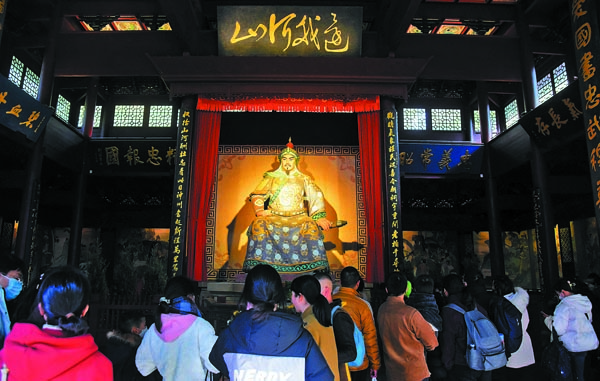
Yue Fei
Introduction
Yue Fei (1103–1142) was a renowned military commander and national hero of the Southern Song Dynasty (1127–1279). Revered as a symbol of loyalty, patriotism, and unwavering dedication to his country, Yue Fei's legacy has endured for centuries in Chinese culture. His life and deeds are celebrated in literature, art, and folklore, and his name is synonymous with the ideals of serving one's nation with unreserved loyalty. Yue Fei's story is deeply intertwined with the famous poem "Man Jiang Hong" ("Full River Red"), which he composed, expressing his steadfast commitment to defending the motherland against foreign invasions.
Legend has it that Yue Fei's mother tattooed the phrase "Jing Zhong Bao Guo" ("Serve the country with unreserved loyalty") on his back, instilling in him a lifelong sense of duty and devotion. This act of maternal guidance has become an iconic representation of Yue Fei's character and values. His tragic downfall, caused by political intrigue and betrayal, further solidified his status as a martyr for justice and loyalty. Today, Yue Fei remains a celebrated figure in Chinese history, inspiring generations through his story and the cultural works dedicated to his memory.
Early Life
Yue Fei was born in 1103 in Tangyin county, Henan province, during the Northern Song Dynasty (960–1127). His early life was marked by poverty, but his mother played a pivotal role in shaping his character and instilling a sense of patriotism. According to legend, Yue Fei's mother tattooed four Chinese characters, "Jing Zhong Bao Guo," on his back, symbolizing the unwavering loyalty he was expected to show toward his country. This act of maternal devotion and guidance became a defining moment in Yue Fei's life, influencing his decisions and actions throughout his career.
From a young age, Yue Fei displayed exceptional intelligence and physical prowess. He trained diligently in martial arts and archery, preparing himself for a life of military service. His dedication to self-improvement and his strong moral compass earned him respect among his peers and mentors.
As the Northern Song Dynasty faced increasing threats from the invading Jin Dynasty (1115–1234) , Yue Fei's sense of duty to protect his homeland grew stronger. These formative years laid the foundation for his rise as one of China's most celebrated military leaders.
Military Career
Yue Fei's military career began during the turbulent period of the Southern Song Dynasty, which emerged after the fall of the Northern Song to the Jin Dynasty. He quickly distinguished himself as a skilled and fearless commander, leading troops in numerous battles against the Jin invaders. Yue Fei's strategic brilliance, coupled with his ability to inspire loyalty among his soldiers, contributed to his success on the battlefield.
One of Yue Fei's most notable achievements was his leadership during the campaigns to reclaim lost territories from the Jin Dynasty. His army, known as the "Yue Family Army," was renowned for its discipline, morale, and effectiveness. Yue Fei's tactics often involved innovative strategies, such as surprise attacks and guerrilla warfare, which allowed his forces to overcome numerically superior enemies.
Despite his military successes, Yue Fei faced challenges from within the Song court. Political factions and rivalries often hindered his efforts, as some officials viewed his growing influence and popularity as a threat. Nevertheless, Yue Fei remained steadfast in his commitment to serving his country, earning the admiration of both his troops and the general populace.
Loyalty and Patriotism
Yue Fei's unwavering loyalty and patriotism were central to his identity and legacy. The phrase "Jing Zhong Bao Guo," tattooed on his back by his mother, served as a constant reminder of his duty to the nation. This sense of devotion was evident in his actions and decisions throughout his military career.
Yue Fei's dedication to his country extended beyond the battlefield. He often advocated for policies that would strengthen the Song Dynasty and improve the lives of its citizens. His integrity and selflessness earned him widespread respect, solidifying his status as a national hero.
Downfall and Death
Despite his military successes and unwavering loyalty, Yue Fei's career was tragically cut short by political intrigue and betrayal. In 1141, Yue Fei was falsely accused of treason by the corrupt chancellor Qin Hui, who conspired with Emperor Zhao Gou to eliminate him. Yue Fei was imprisoned and later executed in 1142, marking the end of his illustrious career.
The charges against Yue Fei were widely regarded as baseless, and his death was seen as a grave injustice. His execution sparked outrage among the populace, who mourned the loss of a true patriot and hero. Over time, Yue Fei's story became a symbol of the struggle against corruption and the importance of loyalty to one's principles.
Legacy
Man Jiang Hong
Yue Fei's famous poem, "Man Jiang Hong" ("Full River Red"), encapsulates his patriotic spirit and determination to defend the motherland. The poem is filled with strong emotions and a resolute commitment to justice, making it a masterpiece in the history of Chinese literature. Its powerful imagery and heartfelt sentiments have inspired generations to uphold the values of loyalty and courage. The poem remains a cultural touchstone, symbolizing patriotism and resistance against oppression.
Memorials and Temples
Numerous memorials and temples have been dedicated to Yue Fei, honoring his contributions and sacrifice. The Temple of Yue Fei in Hangzhou is one of the most famous sites, attracting visitors from across the country. The temple features statues, steles, and inscriptions that commemorate Yue Fei's life and achievements.
Visitors to the Temple of Yue Fei often engage in traditional activities, such as reciting his poem "Man Jiang Hong" or symbolically punishing statues of Qin Hui, the chancellor responsible for Yue Fei's downfall. These rituals reflect the deep admiration and respect that people continue to hold for Yue Fei.
Yue Fei in Literature and Art
Yue Fei's legacy has had a profound impact on Chinese culture, inspiring countless works of literature, art, and performance. His story is celebrated in operas, poems, and historical dramas, each highlighting his unwavering loyalty and tragic fate.
The Puju Opera piece "Yue Mother Tattoos Slogan on Her Son’s Back" dramatizes the iconic moment when Yue Fei's mother tattooed "Jing Zhong Bao Guo" on his back, emphasizing the values of loyalty and patriotism.
In addition to traditional art forms, Yue Fei's legacy has been explored in modern art. For example, the chamber music piece "Man Jiang Hong," composed by Zhao Zeming, was inspired by Yue Fei's poem and reflects his patriotic spirit. The film "Full River Red," directed by Zhang Yimou, drawing attention to Yue Fei's enduring influence. Set during the Southern Song Dynasty, the historical suspense movie tells the story of a group of grassroots patriots who sacrifice their lives to seek revenge for Yue Fei. These works highlight the enduring relevance of Yue Fei's values and the universal appeal of his character.
Through his life, deeds, and the cultural works inspired by him, Yue Fei remains a symbol of loyalty, patriotism, and the pursuit of justice. His story continues to inspire generations, serving as a reminder of the importance of integrity and dedication to one's principles.








